
1. Cold-Die Metal Displacement
Genuine maker marks display raised metallurgical displacement ridges along lettering perimeters with rounded internal root radii under 10x jeweler magnification.
Searchable metallurgical identification matrix for forged American and Swedish axe head stamps. Decode foundry origins, verify era authenticity, and prevent collector counterfeit scams.
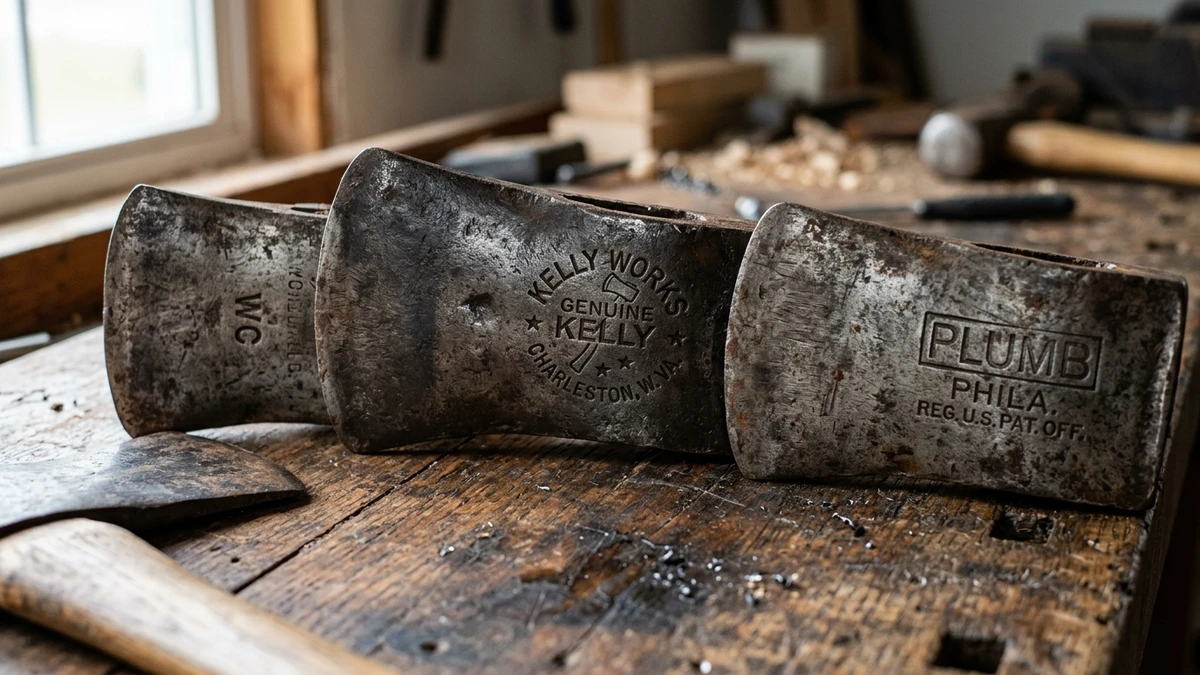
Use the live filter above to isolate foundry marks across American industrial titans (Kelly, Plumb, Collins) and Scandinavian forged heritage (Hults Bruk, S.A. Wetterlings).
| Maker / Foundry | Production Era | Stamp Wording / Mark | Foundry Location | Rarity Tier | Authentication Markers |
|---|---|---|---|---|---|
| Kelly Works (True Temper) | 1930 – 1960s | KELLY DURYEA / FLINT EDGE | Charleston, WV, USA | Sought-After | Deep cold stamp in eye rib; cross-hatched poll on select cruisers; distinct ridge line. |
| True Temper (Kelly Works) | 1940 – 1970s | PERFECT / BLACK RAVEN | Charleston, WV, USA | Grail Tier | Etched raven on branch; raised phantom bevels on Dayton and Jersey felling patterns. |
| Plumb (Fayette R. Plumb) | 1910 – 1970s | PLUMB / ANCHOR LOGO | Philadelphia & St. Louis, USA | Standard Collector | Red Permabond epoxy eye bond introduced 1955; octagon poll bevels; anchor stamp. |
| Collins & Co. | 1870 – 1966 | COLLINS & CO. / HARTFORD | Collinsville, CT, USA | High Rarity (Pre-1966) | Arm and hammer crown stamp; 'LEGITIMUS' crest; deep circular eye temper stamps. |
| Hults Bruk | 1880 – Present | HB / CIRCLE CREST | Åby, Östergötland, Sweden | Collector & Working Classic | Stamped HB cipher; distinct hand-peened cheeks; convex Scandinavian bit temper line. |
| S.A. Wetterlings | 1880 – 2017 | SAW / TWO CROSSED AXES | Storvik, Sweden | Discontinued Grail | Crossed axes cartouche; SAE 1055 equivalent; integrated forge weld line on eye. |
| Mann Edge Tool Co. | 1890 – 1990s | KNOT KLIPPER / TRUE AMERICAN | Lewistown, PA, USA | Standard Collector | Rectangular boxed text; dual raised ridges inside eye; aggressive convex taper. |
| Council Tool | 1886 – Present | COUNCIL / VELVICUT | Lake Waccamaw, NC, USA | Modern Heritage | Drop-forged USA imprint; heat treatment stamp; un-mushroomed chamfered sledge poll. |
Authentic antique axe stamps were pressed directly into carbon steel billets with hardened dies. Inspect cold-die displacement ridges, longitudinal eye broaching, and chemical etching textures to detect modern counterfeit reproductions.
Genuine maker marks display raised metallurgical displacement ridges along lettering perimeters with rounded internal root radii under 10x jeweler magnification.
Acid-etched fakes display chemical undercut terraces and rough stippled floors, while rotary burs leave microscopic machining striations perpendicular to strokes.
Pre-1960 American foundries broached eye sockets with longitudinal internal ribbing designed to seat wooden wedges firmly without rotational slipping.
The primary cause of destroyed collector value in vintage American timber tools is aggressive mechanical abrasive cleaning. Coarse wire wheels attached to high-RPM bench grinders quickly roll over the delicate raised perimeter ridges of cold-stamped lettering within seconds. Once the crisp edge of a True Temper Flint Edge or Collins Legitimus stamp is rounded, metallurgical attribution must rely solely on spark testing and weight geometry.
Always preserve original patina by opting for chemical dissolution. Use our vinegar bath immersion calculator to calibrate acetic acid soak times down to the minute, neutralizing immediately in a saturated baking soda rinse to halt hydrogen embrittlement.
For rare collector pieces exhibiting light surface flash, brass wire hand brushes paired with mineral spirits provide the safest mechanical cleaning threshold without abrading carbon steel grains. Following chemical scale removal, thoroughly desiccate the tool head in a warm workshop oven at 200°F (93°C) for twenty minutes to drive off absorbed interstitial hydrogen atoms before applying an unrefined hot boiled linseed oil barrier.
| Chemistry | Selective Iron Oxide Chelation (pH Neutral) |
|---|---|
| Base Metal Preservation | Zero unreacted steel or forge stamp etching |
| Embrittlement Risk | Zero Hydrogen Embrittlement (Non-Acidic) |
| Soak Duration | 2 to 12 hours depending on scale depth |
| Safety | Biodegradable, non-flammable, skin safe |
Safely dissolves oxide crusts without eating away delicate vintage maker stamps or altering the original temper of vintage forged steel.
| Bristle Material | Solid Brass Wire (Mohs Hardness ~3.0) |
|---|---|
| Substrate Protection | Softer than 54–58 HRC axe steel (No scratching) |
| Handle Design | Ergonomic offset grip for detailed lettering |
| Application | Lifting loosened rust from stamp depressions |
| Durability | High-density crimped wire pack |
Brass bristles will not scratch or scour antique axe cheek patina, making it safe to reveal faint True Temper, Kelly, and Collins stamps.
| Formula | Acid-Free Semi-Synthetic Microcrystalline Wax |
|---|---|
| Application | Formulated for British Museum conservation |
| Barrier Properties | Total moisture barrier; prevents fingerprint rust |
| Finish | Dries hard, non-sticky, transparent matte-satin |
| Compatibility | Safe on steel, wrought iron, and hickory wood |
Used by premier museum curators worldwide. Locks in historical forged patina and prevents flash oxidation without sticky oil film.
Authentic vintage stamps from makers like Kelly or Collins were struck hot or cold with hardened steel dies, creating sharp, uniform deformation with consistent ridge flow. Modern fakes typically show shallow laser engraving, chemical etching with acid bleeds, or uneven hand-dremel marks. Check eye broaching and forge scale to confirm era.
Aggressive wire wheeling or angle grinders will permanently obliterate faint collectible stamps. Use a 5% to 7% mild white vinegar bath (limited to 6–12 hours) or non-destructive electrolysis to lift rust scale without eroding the underlying stamped steel lettering.
In 1955, Fayette R. Plumb patented 'Permabond', an engineered red epoxy compound injected into the axe eye that chemically locked the hickory handle without relying solely on steel wedges. Any Plumb axe retaining original red Permabond dates to 1955 or later.